When Art Crosses Borders: The Creative Connections Shaping European Culture
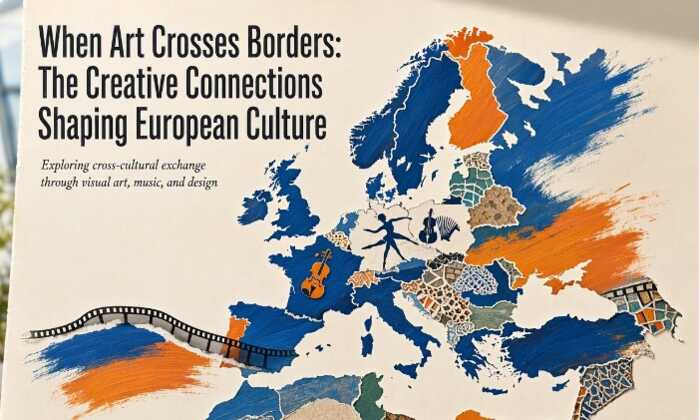
An exhibition may open on a Friday evening, but for the people behind it, the work usually begins much earlier. There are artworks to transport, travel to arrange, invoices to deal with, spaces to prepare, and dozens of smaller decisions that rarely make it into the final exhibition.
For an artist working across Europe, these details are simply part of the job. A painting may travel from Warsaw to Berlin. A photographer might spend several days in Prague for a project. A curator could be coordinating artists, accommodation, equipment, and deadlines across different cities.
Visitors rarely see this part of the process. They encounter the finished work, not everything that had to happen before it arrived on the wall.
Yet these practical journeys have become a familiar part of European creative life. Artists, designers, photographers, curators, and independent cultural organisations are working across borders through exhibitions, residencies, collaborations, and personal connections.
Together, these movements are changing how artists find collaborators, organise projects, and present their work.
Beyond the Traditional Art Capitals
For decades, conversations about European art tended to focus on a familiar group of cultural capitals: Paris, London, Berlin, Venice.
Those cities still matter. But they are no longer the only places where interesting creative work is happening.
Warsaw, for example, has a diverse network of galleries, independent spaces, designers, and cultural organisations. Kraków combines its historic setting with a lively contemporary scene, while Prague continues to attract artists and designers from across Central Europe.
The more interesting story, however, is what happens between these cities.
An artist might spend several months at a residency in Kraków, present the resulting work in Warsaw, and later collaborate with someone based in Berlin. A gallery may invite an artist from another country for an exhibition. A designer can develop much of a project remotely before travelling for its final installation.
These exchanges rarely make international headlines. They are nevertheless changing how creative projects are developed and presented.
The Journey Behind an Exhibition
Visitors usually encounter an exhibition at its most polished moment.
The walls are ready. The works have been installed. Labels are in place. The lighting has been considered. To a visitor, it can look almost effortless.
Behind that opening is a much more practical list.
There may be specialist packaging, transportation, insurance, printing, accommodation, equipment rental, installation costs, and artist fees. For an independent organiser, even a relatively modest exhibition can require careful budgeting.
Currency can add another complication.
Consider a project organised in euros but involving a Polish gallery, accommodation paid for in złoty, and transportation booked in advance. A modest difference in the exchange rate may not matter much to a large institution. For an independent artist working with a limited budget, several smaller differences can add up.
For projects involving Poland, checking exchange rates can therefore be a useful part of planning. Minfin PL provides comparisons of currency rates from Polish banks and exchange offices, which can help when estimating cross-border expenses.
It is a small administrative task, but creative projects are often built around many such details.
Why Smaller Cities Matter
The changing European art scene is not limited to major capitals.
Smaller cities can offer something that is increasingly difficult to find in expensive cultural centres: affordable space and time to experiment.
An independent gallery may have only one exhibition room. A residency might provide a studio for several weeks. A local cultural organisation may have a limited budget but a strong relationship with artists and the community around it.
That can be enough to start something.
A first exhibition can introduce an artist to a curator from another city. A residency can lead to a collaboration that continues long after its participants return home. A local workshop can bring together people who might never have met through the established gallery circuit.
The European cultural scene is shaped by these encounters as much as by major museums and international art fairs.
The Work Nobody Sees
There is still a familiar image of the artist: alone in a studio, following an idea until it becomes an artwork.
For many independent artists, the reality is considerably more practical.
There are emails to answer, invoices to send, travel to arrange, materials to order, contracts to read, and deadlines to keep track of. When a project crosses a border, there may also be different languages, payment systems, tax questions, and delivery arrangements.
Without a large institution behind them, artists often have to manage much of this themselves.
It can be exhausting. It can also be useful.
Knowing how much a project is likely to cost, how long transportation might take, or where an expense can be reduced gives an artist more freedom to decide which ideas can realistically be pursued.
The spreadsheet will probably never appear in the exhibition catalogue. It may still be one of the reasons the exhibition happened at all.
When Local Experience Meets International Collaboration
International collaboration does not mean leaving local identity behind.
Often, the most interesting part of a collaboration is precisely what each person brings from their own environment.
Artists carry their references with them: the places where they grew up, the architecture they know, the history around them, and the visual language of their city. When those experiences meet someone else's, the differences can become productive.
A Polish photographer working with a German curator may approach a familiar subject differently after a conversation. A designer from Prague collaborating with a Warsaw studio may introduce ideas shaped by another visual culture.
Their value lies in the friction between different perspectives — in having to explain, adapt, compromise, and sometimes rethink an idea.
Central Europe makes this particularly visible. Its cities share parts of a complicated history, yet their contemporary cultural scenes have developed in distinctly different ways. That creates room for exchange without requiring every project to look or feel the same.
A Network Rather Than a Single Centre
It is tempting to ask which European city will become the next major art capital.
Perhaps a better question is how the existing cities are becoming connected.
A residency in Kraków can lead to an exhibition in Warsaw. A conversation in Berlin can turn into a project in Prague. An artist discovered at an independent space can later become part of a larger international programme.
Most of these connections happen quietly. There is no official moment when a new cultural network comes into existence. It grows through introductions, emails, studio visits, recommendations, and people choosing to work together again.
It is easy to overlook this process because there is rarely a single event that marks it. But over time, these small connections can change where artists work, who they work with, and which ideas travel.
The movement of an artwork is only part of its story. By the time a work reaches the wall, it may already have travelled through another studio, another city, or another country.