Beyond Images of Environmental Crisis: How Art Makes Loss Visible
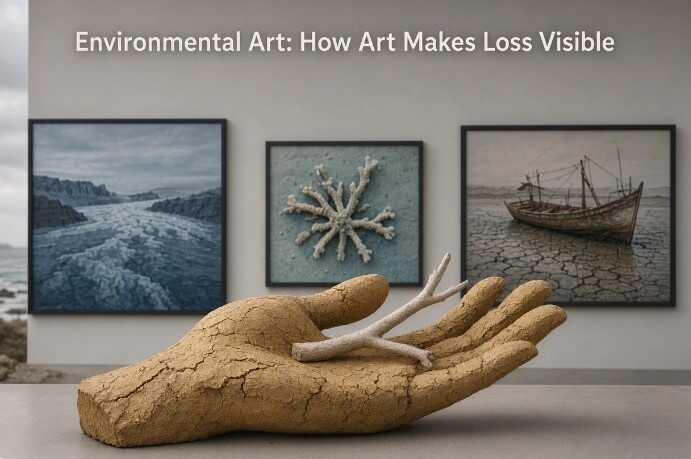
From melting glaciers to disappearing species and contested urban land, environmental art asks a question that images of catastrophe alone cannot answer: what does it take to make a loss matter?
A block of glacial ice sits in a city square, slowly melting under the eyes of passers-by. Someone might stop, touch its surface, take a photograph and continue with the day. The ice comes from a landscape most people will never visit, yet its disappearance is connected to decisions shaping their own lives. For a moment, a distant environmental process becomes physical and difficult to ignore.
Images of environmental crisis are everywhere: satellite photographs of shrinking ice sheets, aerial views of burning forests, footage of floods and droughts. They make damage visible, but repeated exposure does not necessarily make a crisis feel immediate. A problem can be documented endlessly without becoming a meaningful part of everyday life.
Environmental art approaches this gap between knowledge and experience in different ways. It can bring a remote process into physical space, preserve memories of an altered natural world or confront viewers with the long-term consequences of how land is used. Three projects—by Olafur Eliasson and geologist Minik Rosing, Maya Lin, and Agnes Denes—show how these strategies work and where their limitations become visible.
When Climate Change Becomes a Physical Experience
In December 2018, Ice Watch, a collaboration between artist Olafur Eliasson and geologist Minik Rosing, brought 30 blocks of glacial ice from Greenland to London. Installed outside Tate Modern and Bloomberg’s European headquarters, the work placed fragments of a changing Arctic landscape in the middle of a busy city.
The premise was simple: instead of looking at a photograph of a glacier or reading about rising global temperatures, visitors could stand beside the ice, touch it and watch it melt. Its changing shape made time visible. A process usually understood through scientific measurements unfolded in front of them.
The location sharpened the contrast. The ice appeared in a major financial and cultural centre, connecting a remote environmental transformation with the institutions and economic systems that shape contemporary life. Yet the installation also raised an uncomfortable question: what was the environmental cost of bringing the ice there?
The published carbon-footprint figures do not agree. A detailed carbon-footprint report prepared by Julie’s Bicycle gives Ice Watch London a total footprint of 55 tonnes of carbon-dioxide equivalent (CO₂e). It attributes 45 tonnes—about 82 per cent of the total—to freight, with a further 9 tonnes from team travel and 1 tonne from the exhibition’s power use. However, a 24 January 2019 post on Studio Olafur Eliasson’s website describes the same project’s final report as giving a total of 39 tonnes CO₂e, or 1.3 tonnes per block. Later summaries by Julie’s Bicycle continue to cite 55 tonnes. The publicly available sources do not explain the discrepancy. The breakdown discussed here therefore follows the detailed report’s 55-tonne total.
The freight figure nevertheless reveals the scale of the logistical cost. The work’s environmental footprint was not a minor detail: transporting the ice accounted for most of the emissions in the detailed assessment. Studio Olafur Eliasson also reported donating to the Woodland Trust an amount exceeding the estimated cost of a conventional carbon offset. That response acknowledged the emissions, but it did not erase them.
The contradiction does not automatically invalidate Ice Watch. It complicates the experience the work offers. Visitors could touch the ice, but they could not touch the shipping infrastructure, energy systems or economic decisions that contribute to the wider climate crisis. The installation made melting tangible while leaving many of its causes outside the immediate encounter.
That is both the work’s strength and its limitation. It gave a distant environmental process a physical presence, but understanding the process still required information beyond the spectacle of melting ice.
What Happens When a Landscape Disappears?
Not all environmental loss arrives as a dramatic event. Some happens gradually, until a diminished landscape begins to feel normal. A species becomes rare, a familiar sound disappears, or a habitat changes so slowly that people no longer remember what was there before.
Artist Maya Lin’s ongoing project What Is Missing?, launched in 2009, addresses this quieter form of loss. Conceived as a memorial to biodiversity and the natural world, it combines physical artworks, sound, images and a digital platform to document threatened and extinct species, damaged ecosystems and the relationships between people and their environments.
The project challenges the idea that a memorial must commemorate a single person or a clearly defined historical event. Its subject is collective disappearance: the loss of species, habitats and ecological relationships that may go unnoticed within a single lifetime.
This approach addresses what ecologists call shifting baselines: each generation can come to regard the natural world it inherits as normal, even when it is already diminished. A record of former abundance can reveal a loss that would otherwise be difficult to recognise. Yet memory has its own limitation. Knowing that a species once lived in a particular place does not, on its own, restore the conditions it needs to survive.
In September 2026, Princeton University opened What Is Missing? What If?, a distinct exhibition built around Lin’s project. Its centrepiece is a two-storey multimedia display in which threatened and endangered animals appear at life size. A giraffe seems to walk past visitors; a tiger moves through a forest; a whale rises across a wall, accompanied by the sound of its song. The effect is to place the scale and presence of animal life within an everyday institutional space.
Elsewhere, an interactive learning area invites visitors to share memories of former abundance and explore nature-based solutions. The exhibition’s Greenprint wall highlights examples of sustainability, conservation, transport and renewable energy. These elements shift the emphasis from recording disappearance alone to showing that environmental outcomes are not fixed.
A display of threatened species can make loss emotionally legible, but it can also turn living creatures into images to be viewed and then left behind. By pairing those images with memories and examples of possible action, Lin’s exhibition connects recognition with the possibility of recovery. Whether visitors carry that connection beyond the gallery remains an open question. One of the exhibition’s clearest contributions is to place ecological loss and possible responses to it within the same space.
A Wheat Field Where the City Values Land in Money
In May 1982, Agnes Denes planted a two-acre wheat field on a landfill in lower Manhattan, near Wall Street and the World Trade Center and facing the Statue of Liberty. The site would become part of Battery Park City. Wheatfield—A Confrontation placed a basic food crop in a landscape associated with financial power, turning land use itself into the subject of the work.
Wheat requires time, care, soil and a natural growing cycle before it can be harvested. The surrounding city represented another system of value, in which land could be assessed in billions of dollars. Denes brought these competing values into the same frame: food and finance, biological time and investment, human needs and the price of urban land.
The work was not simply a pastoral image inserted into the city. It occupied valuable land for a purpose that challenged the logic of maximising its immediate economic return. That made the field a direct question about priorities: what is land for, and whose needs determine its use?
The intervention was temporary, and it did not itself alter the economic system surrounding it. Its force lay in making that system appear less inevitable and exposing the assumptions behind the valuation of urban land. Its limits are equally important: a field can evoke food security without addressing the distribution of food, access to land or the economic conditions that shape agricultural production. Denes’s work makes these questions visible, but leaves their practical resolution to institutions, policymakers and society.
Forty years later, her project Another Confrontation, commissioned by CIRCA in 2022, revisited these concerns through three moving-image works presented on public screens, an augmented-reality wheat field and a questionnaire intended to connect the present with the distant future.
The commission unfolded in three acts. The first returned to Wheatfield—A Confrontation and its challenge to prevailing economic priorities. The second turned to Tree Mountain—A Living Time Capsule, conceived by Denes in 1982 and realised in Finland in 1996. The work consists of 11,000 trees planted by 11,000 people according to a mathematical pattern on a man-made mountain. The site is protected from alteration and disturbance for 400 years, until 2396.
The third act invited the public to answer eleven questions about humanity and the world in 2022. Responses were intended to be sealed in a time capsule and opened in 3022. The project thus connected three timescales: a temporary urban intervention, a living landscape protected for centuries, and a message intended for people a thousand years in the future.
This structure gives Another Confrontation its particular force. Wheatfield challenged the immediate valuation of land; Tree Mountain turned long-term stewardship into a physical commitment; the time capsule asked participants to imagine how their present might appear to future generations. Rather than treating the future as an abstraction, the project gave it a date and a material form.
But a protected landscape and a time capsule cannot guarantee that future societies will share the values they represent. The works make the duration of responsibility visible without determining what future generations will do with it.
Denes’s recurring question remains relevant: who decides what land is worth, and how should that decision change when its consequences extend beyond the people making it?
The Problem With Beautiful Environmental Art
The works discussed here use striking visual forms: melting ice, life-size animal projections and a wheat field surrounded by skyscrapers. Beauty and spectacle can attract attention, but they can also make environmental crisis easier to consume than to confront.
The differences between the projects matter. In Ice Watch, the emissions associated with transporting the ice complicate the experience of the melting blocks. In Lin’s exhibition, threatened species appear alongside examples of conservation and sustainability. In Denes’s projects, the short life of a wheat field is set against a landscape designed to endure for centuries.
These details prevent the works from being reduced to attractive symbols. They bring material costs, changing baselines and competing ideas of value into the interpretation of the image. They also expose what remains outside it: the infrastructure behind emissions, the conditions needed to protect biodiversity, and the political and economic decisions that determine how land is used.
A powerful image can begin a conversation, but its significance depends partly on what viewers do with the questions it raises. Environmental art can invite reconsideration; it cannot, by itself, guarantee changes in policy, behaviour or ecological conditions.
What Remains After the Image?
Environmental art does not reverse extinction or halt the melting of glaciers. Its significance lies in making processes visible that might otherwise remain distant, normalised or difficult to imagine.
Across these projects, ice makes climate change physical, Lin’s archive challenges the fading memory of biodiversity, and Denes’s fields connect land use to obligations that stretch across generations. Each offers a different way of recognising loss, while leaving the practical work of responding to it unresolved.
Once a loss becomes visible, the question is no longer only what we see. What are we prepared to change because of it?