After the Gallery Closes: The Challenge of Preserving Contemporary Art
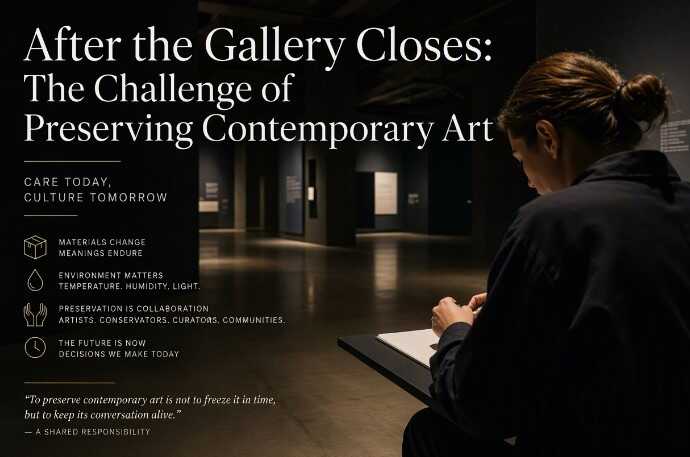
When an exhibition closes, the galleries begin to empty. Labels come down, walls are repainted, borrowed objects are packed into crates, and the rooms are prepared for whatever comes next. For visitors, the exhibition may already feel like a finished experience. For the people responsible for caring for the art, however, its ending can mark the beginning of a different kind of work.
Not every artwork can simply be wrapped, stored, and brought out again years later. Contemporary art can depend on movement, sound, participation, specific materials, or the presence of people who know how to make it work. Some pieces are designed to deteriorate or change. Others exist only when they are performed. Preserving them means asking a difficult question: what, exactly, needs to survive?
The Work Behind an Exhibition’s Final Day
Dismantling an exhibition is more than the reverse of installing it. Before an artwork is removed, conservators and curators may need to record its condition, photograph its arrangement, document technical settings, and make decisions about how each component should be stored. For a conventional painting, these tasks may focus on the physical object. For a complex installation, they can involve the entire environment around it.
The position of a projector, the level of ambient light, the relationship between separate objects, or the route visitors take through a room may all contribute to the work. If those details are lost, a future installation might contain the same materials but produce a very different experience.
Documentation helps bridge that gap. Photographs, installation plans, video recordings, written instructions, interviews, and technical notes can preserve information that would otherwise disappear when the exhibition ends. Yet documentation is not a neutral record of everything that happened. Someone has to decide what matters enough to record, and no set of photographs can fully reproduce the experience of standing in the room.
When Preserving an Artwork Means More Than Saving an Object
The work of American artist and musician Tony Conrad offers a revealing example. His performance Ten Years Alive on the Infinite Plain, first presented in 1972, combines experimental music with visual elements. Its configuration has evolved over subsequent performances, making its preservation more complicated than keeping a fixed object in storage. While later iterations have combined live experimental music with film projections, the original 1972 presentation used video.
After Conrad’s death in 2016, Tate researchers and conservators faced the challenge of considering how the performance could continue without its original creator to teach it directly. There was no definitive score that could settle every question about how it should be performed. Knowledge had been carried by Conrad and by the musicians and collaborators who had worked with him.
Tate developed a “dossier for transmission” that brought together written guidance, historical information, audio and video recordings, and practical instructions for performers and technicians. The material was tested with new performers at Tate Liverpool in 2019. The process revealed that documentation could help transmit the work, but it could not remove every uncertainty. Questions about interpretation, improvisation, and the relationship between past and future performances still required discussion and judgement.
This approach changes the meaning of conservation. The goal is not simply to preserve a single, definitive version. It is to make future performances possible while acknowledging the work’s history, its variations, and the people whose knowledge helps sustain it.
What Documentation Can—and Cannot—Preserve
Recording an artwork is not the same as preserving it. A video can show how a performance unfolded, but it cannot recreate the original event. It cannot reproduce the atmosphere of a particular room, the physical presence of the audience, or the decisions made by performers in response to one another.
The same limitation applies to installation art. A photograph may record the arrangement of objects, but it may not explain why they were placed at particular distances or how visitors were expected to move among them. Technical instructions can describe equipment and settings, while interviews may capture the knowledge that artists and technicians would not necessarily think to write down.
For this reason, effective documentation often draws on several kinds of evidence. It may combine visual records with written accounts, conversations with artists and collaborators, technical measurements, and observations from earlier installations. The aim is not to eliminate interpretation, but to give future teams enough information to make informed decisions.
Even extensive records have limits. People forget details, equipment becomes obsolete, and the meaning of a work can shift as it enters a new context. A conservation file is therefore not always a final set of instructions. It can be a record of what is known, what has changed, and what remains open to interpretation.
When Change Is Part of the Work
Some artworks make the problem even more apparent because their materials are meant to change. Roelof Louw’s Soul City (Pyramid of Oranges), created in 1967, is a well-known example. The work consists of a pyramid of oranges that visitors are invited to take and eat. As people interact with it, the structure gradually changes.
In a 2016 reconstruction at Tate Britain, nearly 6,000 oranges were piled into the gallery. The work’s appearance was never entirely fixed: each orange removed by a visitor altered the pyramid, and participation became part of the piece rather than an interruption of it.
Conserving such a work cannot mean keeping every original component intact. The fruit is perishable, so its condition must be considered during display. This practical concern is distinct from the audience participation that gives the work its meaning.
The challenge is deciding which elements are essential. Is it the exact arrangement of the oranges, the invitation to take one, the gradual disappearance of the pyramid, or the social encounter created around it? The answer affects how the work can be presented again. Replacing materials may be necessary, but replacement alone does not guarantee that the work’s central idea will survive.
This is one of the questions that makes contemporary art conservation so distinctive. The physical materials matter, but they may be only one part of what needs to be carried forward.
The Environmental Cost of Starting Again
Recreating an artwork can also have a material cost. Large installations may require new timber, plastics, printed surfaces, lighting, electronics, transport, and specialist equipment. When a work is rebuilt for each exhibition, the repeated use of resources becomes part of the conservation question.
There is no single answer for every artwork. Some materials can be stored and reused; others may be too fragile, too expensive to maintain, or unsuitable for another presentation. Electronic components can become difficult to replace as manufacturers discontinue them. A display that once depended on familiar technology may eventually require a carefully considered substitute.
Conservators therefore need to balance fidelity with practicality. Reusing components can reduce waste, but only when those materials remain safe and suitable for the work. Replacing an outdated device may help keep an installation accessible, although the new technology may alter its appearance or behaviour.
These decisions benefit from being recorded. Future teams need to understand not only what was changed, but why. A transparent account of substitutions and compromises allows later presentations to build on previous experience instead of repeating the same investigations.
Who Decides What Survives?
Conservation is often described as a technical discipline, but many of its most difficult questions are interpretive. If an artist is no longer alive, who decides whether a component can be replaced or an instruction adapted? How much can a performance change before it becomes a different work? And whose knowledge should guide those decisions?
Artists, estates, curators, conservators, technicians, performers, and past collaborators may all hold different parts of the answer. Their perspectives do not always align. An artist may value the freedom to experiment, while a museum needs enough consistency to identify and care for a work over time. A performer may understand an instruction through experience that cannot easily be translated into a manual.
These differences do not necessarily mean that conservation has failed. They can reveal how an artwork has been made, used, and understood. Recording disagreements and decisions can be as important as documenting the final installation, particularly when a work is expected to be presented again in the future.
Museums are not simply keeping objects safe from change. They are also deciding how artworks will be encountered by people who were not present when they were first made. That responsibility calls for careful research, collaboration, and a willingness to acknowledge uncertainty.
After the Exhibition
When the gallery closes, an artwork’s life does not necessarily come to an end. It may continue in storage, in a collection file, in the memories of its performers, or in the decisions made before its next presentation. For some works, the next chapter begins with a careful reconstruction. For others, it depends on finding ways to preserve an action, an atmosphere, or an invitation to participate.
The task is not always to return an artwork to exactly the state it occupied before. Sometimes that state was never fixed in the first place. Preservation can instead mean understanding what gives a work its identity, recording how it has changed, and making thoughtful choices about what should happen next.
Contemporary art asks museums to look beyond the object alone. What survives may be a set of materials, a performance, a method, or a relationship between an artwork and its audience. The exhibition may be temporary, but the responsibility to care for what it leaves behind continues long after the doors close.