When Art Is Designed for the Camera
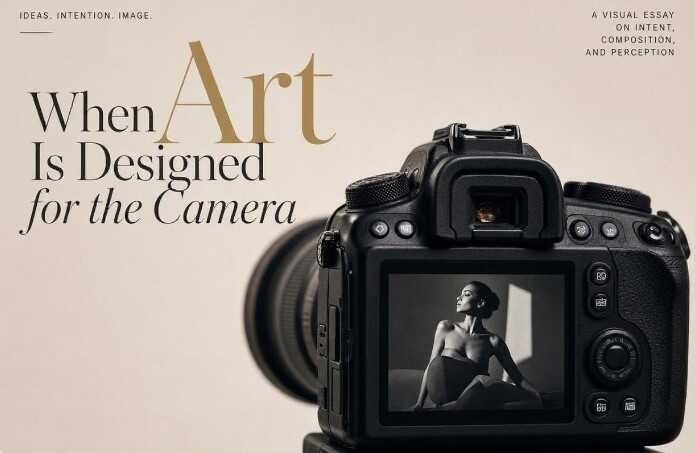
There is a familiar moment in contemporary art spaces. Something catches your eye, and before you have quite decided what you are looking at, your phone is already in your hand.
You take a picture. Perhaps another. You check the frame, move closer, step back, wait for the light to look right.
Sometimes the photograph is simply a way of remembering what you saw. Sometimes it becomes part of the experience itself.
That distinction is becoming harder to ignore.
The camera is no longer just a device for documenting art after the fact. It has become part of the environment in which contemporary art is made, encountered, shared and remembered.
And this raises a more interesting question than whether visitors spend too much time on their phones: what happens when an artwork begins to anticipate the camera?
The question is not whether artists are deliberately designing everything for social media, but whether the camera has quietly become part of the conditions under which art is made, exhibited and remembered.
When an artwork acquires a second life
For much of modern exhibition culture, an artwork's relationship with its audience was still largely tied to the physical space in which it was encountered. Scale mattered. Texture mattered. Distance mattered. So did the particular feeling of standing in the same room as something that could not be reduced to a reproduction.
Today, a work can acquire another existence almost immediately.
It can become a photograph, a Reel, a TikTok, a story, a profile picture or a backdrop for someone's portrait. Someone who has never visited the gallery can encounter it thousands of kilometres away, compressed into the dimensions of a phone.
This has changed the reach of art in remarkable ways. An emerging artist can find an audience without waiting for a major exhibition or a critic's review. A single image can travel further than the physical work ever could.
But visibility comes with its own logic.
A camera tends to favour certain qualities: scale, colour, symmetry, spectacle, recognisable forms and dramatic spaces. It favours what can be understood quickly within a frame.
Art, however, has never promised to reveal everything at first glance.
Yayoi Kusama and the artwork that found a new photographic life
Few artists demonstrate the complicated relationship between physical experience and photographic circulation better than Yayoi Kusama.
What makes Kusama particularly revealing is that her mirror rooms existed long before Instagram. Infinity Mirror Room—Phalli's Field dates to 1965, decades before smartphones and social media became part of everyday life. Kusama used mirrors to transform repetition into a perceptual experience, making the viewer part of the work rather than simply placing them in front of it.
The original work therefore belonged to a very different technological and cultural moment. Its mirrors were not designed to produce a perfect social-media image. They multiplied the visitor, altered the perception of space and turned the viewer's own body into part of the experience.
Decades later, however, those same qualities made Kusama's installations remarkably compatible with image culture.
When the Hirshhorn presented Yayoi Kusama: Infinity Mirrors in 2017, visitors encountered a body of work that had been conceived long before Instagram but was now circulating through a culture built around photographs, selfies and shared visual experiences. The exhibition presented six Infinity Mirror Rooms, allowing visitors to enter the environments rather than simply look at them.
This distinction matters. Kusama did not need Instagram in order to invent the mirror room. Instagram simply gave the work a new way to travel.
That is different from creating art specifically for image culture. It shows how an artwork can acquire a new life when the conditions around it change.
The photograph becomes part of that second life. A visitor standing inside a mirrored room is experiencing the work physically while also producing an image of that experience for someone elsewhere. In Kusama's case, the two activities can even reinforce one another: the reflected body is already part of the visual structure of the installation.
The camera did not create the experience. It amplified one aspect of it.
The photographic afterlife of an artwork
This idea of a photographic afterlife has become increasingly important in contemporary exhibition culture.
teamLab Borderless in Tokyo offers a revealing example. The immersive museum allows visitors to take photographs and videos and to share them on social media. The institution itself notes that the museum appears in a great many social-media posts.
Once an installation is photographed, its life does not necessarily end when the visitor leaves. A room can become a post almost instantly. A moving environment can become a short video, while the visitor becomes part of the image.
The physical encounter now has a photographic afterlife.
This does not necessarily make the experience less meaningful. It can give an artwork a reach that its physical location alone could never provide.
But the relationship can also run in the opposite direction.
For many visitors, the image comes before the encounter.
They may see an installation online long before they ever enter the gallery. By the time they arrive, they may already know what it is supposed to look like, where people stand, what kind of photograph to take and what moment they are expected to capture.
The photograph, then, is no longer simply the afterlife of the artwork. It can become part of the expectation that precedes the artwork.
That creates a loop: the work produces an image, the image circulates, the circulation creates expectations, and those expectations can shape the next physical encounter.
When the camera enters the artist's studio
This may be the more significant shift.
It is one thing for visitors to photograph an artwork after it has been made. It is another for the possibility of being photographed to exist in the artist's mind before the work is finished.
What does an artist consider when they know that the first encounter many people have with their work may not happen in a gallery at all?
It might happen through a curator's Instagram post, a journalist's photograph, a friend's story or a short video watched without sound.
That possibility does not mean artists are consciously designing everything for social media. The influence can be much subtler.
A large installation might be conceived with the knowledge that photographs will become one of its main forms of circulation. Lighting can be experienced differently by the human eye and by a camera. Scale can shape the physical experience of a person moving through the work while also determining how easily that experience can be represented in a single frame.
Even the position of the viewer can matter.
An artist may be thinking about the body moving through a space, but also about the image of that body inside the space. The artwork may therefore need to function in several contexts at once: in the room, on the screen and in the memory created by both.
This is what makes the idea of design before the camera so important.
The camera does not have to be physically present in the studio to influence the conditions under which an artwork is conceived.
Some artworks invite the camera in. Others reveal what it leaves out.
There is another, quieter model of contemporary art that pushes against this logic.
Pipilotti Rist's Pixelwald Wisera, part of the permanent exhibition at Kunsthalle Bremen since February 2025, fills a darkened space with almost 3,000 suspended LED lights. The lights form fragments of a three-dimensional video environment, accompanied by music and designed to be experienced by moving through the space.
It is visually striking, but the work cannot be fully contained within a single frame. There is no ideal viewpoint from which the installation becomes complete. The visitor moves through it; sound changes the atmosphere; colour and light shift around the body.
A photograph can show what it looks like, but it cannot quite show what it is like to be there.
Some artworks invite the camera in. Others reveal what the camera leaves out.
What happens to art that does not photograph well?
This may be the more interesting question.
If cultural attention increasingly passes through images, what happens to work that resists them?
Consider an artwork that is deliberately quiet. One that relies on subtle changes of light. One that requires ten minutes rather than ten seconds. One whose most important quality is its material texture, its sound, its scale or the way it changes as the viewer moves around it.
Such work may be deeply rewarding in person and almost invisible online.
It has no obvious moment. There may be no single frame that explains why the work matters.
And yet that may be precisely what makes it valuable.
Not every meaningful experience produces a good image.
The attention economy and the aesthetics of visibility
The issue is not simply that people may have less patience for slow experiences. The deeper change is that attention itself has become a scarce resource.
Images compete with other images. Exhibitions compete with exhibitions. Artists compete not only for physical audiences but for the possibility of being noticed in an environment where countless visual experiences are available at once.
This may create something more subtle than a change in viewing habits: an aesthetic preference.
A work that changes slowly over twenty minutes, for example, may be harder to share than an installation that produces a dramatic image within seconds. Neither experience is necessarily more valuable. But one has an obvious advantage in an environment organised around rapid visual circulation.
In the same way, bright colours may stand out more readily than muted ones, while large installations may translate more easily into photographs than intimate works. These are not rules, and artists are not simply following an algorithm. But the systems through which art becomes visible can influence what gets noticed, discussed and remembered.
Digital platforms make that process unusually visible. A work can accumulate thousands of views while another, perhaps equally ambitious, remains almost invisible because its qualities are difficult to communicate in a single image.
The question is therefore not whether social media has made art superficial. It is whether an economy built around visibility can gradually create preferences about what art should look like before we have consciously decided what we value.
When visibility becomes part of value
This is where the question becomes larger than photography.
An artwork that circulates widely can attract invitations, press coverage, new audiences and collectors. An exhibition that becomes widely shared online can reach people who might otherwise never walk through its doors.
There is nothing inherently superficial about that. Visibility can be a genuine form of cultural access.
But visibility is no longer simply a consequence of value. It can become part of how value is produced.
The sequence can be circular: an image attracts attention, attention produces recognition, recognition creates cultural visibility, and visibility makes the work more likely to be encountered again.
Meanwhile, quieter work can struggle to enter the same cycle.
A work may be photographed thousands of times and barely looked at. An exhibition may become known for one installation while the quieter works around it disappear from public memory.
Popularity can begin to influence what we remember before we have decided what deserves to be remembered.
Perhaps the problem is not the camera
It would be easy to turn this into another argument about phones in museums. But that would miss the larger shift.
The camera has become part of the environment in which contemporary art is made, encountered and remembered.
The more interesting question is whether an artwork can have more than one kind of life.
It can be photographed and still be experienced. It can circulate online and still demand patience. It can look compelling on a screen without being reduced to the screen.
The challenge is not to choose between digital visibility and physical presence. It is to make sure that one does not quietly replace the other.
Beyond the perfect image
Perhaps the most interesting future for contemporary art will not belong exclusively to works that reject the camera, nor to those that embrace it completely.
It may instead belong to work that understands the difference.
An artwork can be photographed without being exhausted by its photograph. It can circulate widely while retaining something that cannot be uploaded, reposted or reduced to a thumbnail.
And perhaps that is what we should look for the next time we enter a gallery.
Not just the work that makes us reach for our phones.
But the work that makes us put them away.
Because in a culture where almost everything is designed to be seen, there may still be something quietly radical about creating art that asks us to stay.