When Museums Become Social Spaces
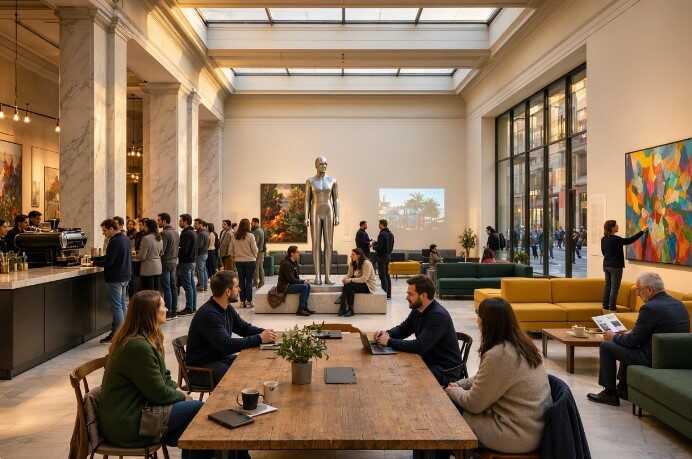
You can spend an hour in a museum without looking at art for most of it.
You might arrive early for a talk and find yourself sitting in the courtyard. You might meet a friend for coffee, wander into an exhibition afterwards and stay longer than planned. Someone nearby may be taking part in a workshop, while another visitor has simply found a quiet place to read.
These scenes are becoming less unusual as museums rethink how their spaces are used.
In museums across different cities, spaces that once served mainly as entrances, corridors or waiting areas are being turned into places for conversation, workshops, performances and informal gatherings. The collection is still at the heart of the institution, but the experience around it is becoming more flexible.
That raises an interesting question: what happens when the museum becomes somewhere people come to spend time, rather than somewhere they visit only to see something?
More Than a Place to Look
The traditional museum visit has a familiar rhythm. You enter, follow a route through the galleries, stop in front of a few works and eventually make your way back outside.
There is plenty to value in that kind of visit. Museums give people rare opportunities to slow down and look closely, often without the distractions of everyday life.
Yet the same buildings can accommodate very different kinds of encounters.
A discussion can send an exhibition in a new direction. A workshop can bring people into contact with an artist or an idea through making rather than simply observing. A reading, film night or community event can attract people who might not have considered visiting for an exhibition alone.
This is where the idea of the museum as a “third place” becomes useful. The term usually describes somewhere between home and work where people can spend time informally. Museums have something many other public spaces lack: they already offer a subject for conversation.
In this sense, a social museum is not simply a museum with more events. It is a place where being together becomes part of the experience.
A Place Worth Staying For
Munich’s Pinakothek der Moderne offers a good example with FLUX, a space designed to give visitors somewhere to stay before or after an exhibition.
It includes areas for sitting, food, cultural programming and both indoor and outdoor activities. Visitors can use the space without buying anything or attending an exhibition.
The project also involved people from outside the museum. Artist Morag Myerscough worked with local communities, with more than 1,500 people taking part in workshops, painting sessions and other stages of the project. In April 2026, FLUX expanded again with a new treehouse installation in the museum’s Winter Garden.
Since opening in June 2025, the space has attracted around 90,000 visitors, with roughly 23,000 taking part in its programme.
More interestingly, people are using the space in very different ways. Someone can come for an exhibition and end up staying for an event. Another person may come simply because there is somewhere to sit. The museum becomes part of the afternoon rather than a single stop on it.
From Participation to Co-Creation
Once visitors are invited to stay, the next question is what they can contribute.
At Cologne’s Rautenstrauch-Joest Museum, the YELLOW ROOM is used for co-creation, discussion and collective learning alongside the permanent exhibition. Its programme includes workshops, readings, film evenings, talks and book presentations, often developed with communities in Cologne.
The visitor is no longer only there to receive what the museum has prepared. People can help shape what takes place inside it.
BERLIN GLOBAL pushes the same idea further through its Open Space programme. One current project, Time Machine Infinitum – Queer migrant Berlin, brings artists and contributors together to explore queer migrant histories, experiences and possible futures in the city.
A room for discussion can lead to participation. Over time, that participation can also influence what a museum chooses to show and whose experiences become part of its story.
For institutions working with complex histories, this can be particularly valuable. Different generations and communities bring knowledge that may not be found in the collection itself.
One of the Few Places Where You Can Just Be
There is another reason this shift matters, and it has less to do with museums than with cities.
There are countless places where people can spend time if they are willing to buy something. Cafés, restaurants, shopping centres and entertainment venues all have their own expectations. Truly public places where you can sit, meet someone, attend an event or simply do nothing for a while can be surprisingly hard to find.
Museums already have much of the infrastructure needed for that kind of space: courtyards, libraries, auditoriums, cafés, gardens and rooms that can be adapted for different uses.
They also have an advantage over many commercial venues. A person does not necessarily need to consume anything to have a reason to be there.
Being physically open, however, is not the same as being genuinely accessible. Ticket prices, opening hours, language and physical access all affect who feels comfortable entering and staying.
That makes seemingly modest decisions significant. A free programme, a place to sit without making a purchase, a community workshop or an evening event can change who sees the museum as a space that belongs in their routine.
The Visit Can Continue After the Gallery
None of this asks museums to give up the quiet experience of looking at art. There will always be a place for the visitor who wants to walk through a gallery alone and spend twenty minutes with one painting.
The difference is that this no longer has to be the only way to use the building.
You can arrive for an exhibition and end up in a conversation. You can come for a workshop and discover an artist you had never encountered before. You can meet someone there without having planned to spend the afternoon at a museum at all.
Perhaps that is the more interesting change. The museum visit does not necessarily finish when you leave the final gallery.
Sometimes the most memorable part happens afterwards — in the conversation that continues long after you have left the gallery.